
In his new encyclical , Pope Francis makes extensive reference to the statements of John Paul II and Benedict XVI on the environment. In fact, the current Pope has written nothing novel on the issue of ecology; he merely repeats the teaching of the Magisterium, expressed by his last two predecessors.
Benedict XVI’s two main documents on ecology are his encyclical “Caritas in veritate” in 2009, and his Message for the 2010 World Day of Peace, with the theme “If you want to cultivate peace, protect creation”.
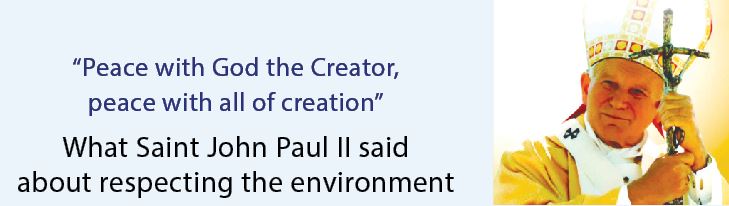
As for John Paul II, it was he who, in November 1979 had named St. Francis of Assisi patron saint of ecologists. The two main documents of John Paul II on ecology are his encyclical “Centesimus Annus” in 1991, and his Message for the 1990 World Day of Peace, with the theme “Peace with God the Creator, peace with all creation.” Here are large excerpts from this Message of January 1st, 1990, which can be said to be a good summary of Pope Francis’ new encyclical “Laudato Si”:
Faced with the widespread destruction of the environment, people everywhere are coming to understand that we cannot continue to use the goods of the earth as we have in the past. The public in general as well as political leaders are concerned about this problem, and experts from a wide range of disciplines are studying its causes. Moreover, a new ecological awareness is beginning to emerge which, rather than being downplayed, ought to be encouraged to develop into concrete programmes and initiatives.
When man turns his back on the Creator’s plan, he provokes a disorder which has inevitable repercussions on the rest of the created order. If man is not at peace with God, then earth itself cannot be at peace: “Therefore the land mourns and all who dwell in it languish, and also the beasts of the field and the birds of the air and even the fish of the sea are taken away” (Hos 4:3).
Certain elements of today’s ecological crisis reveal its moral character. First among these is the indiscriminate application of advances in science and technology. Many recent discoveries have brought undeniable benefits to humanity. Indeed, they demonstrate the nobility of the human vocation to participate responsibly in God’s creative action in the world.
Unfortunately, it is now clear that the application of these discoveries in the fields of industry and agriculture have produced harmful long-term effects. This has led to the painful realization that we cannot interfere in one area of the ecosystem without paying due attention both to the consequences of such interference in other areas and to the well-being of future generations.
The most profound and serious indication of the moral implications underlying the ecological problem is the lack of respect for life evident in many of the patterns of environmental pollution. Often, the interests of production prevail over concern for the dignity of workers, while economic interests take priority over the good of individuals and even entire peoples. In these cases, pollution or environmental destruction is the result of an unnatural and reductionist vision which at times leads to a genuine contempt for man.
On another level, delicate ecological balances are upset by the uncontrolled destruction of animal and plant life or by a reckless exploitation of natural resources. It should be pointed out that all of this, even if carried out in the name of progress and well-being, is ultimately to mankind’s disadvantage.
Finally, we can only look with deep concern at the enormous possibilities of biological research. We are not yet in a position to assess the biological disturbance that could result from indiscriminate genetic manipulation and from the unscrupulous development of new forms of plant and animal life, to say nothing of unacceptable experimentation regarding the origins of human life itself. It is evident to all that in any area as delicate as this, indifference to fundamental ethical norms, or their rejection, would lead mankind to the very threshold of self-destruction.
Respect for life, and above all for the dignity of the human person, is the ultimate guiding norm for any sound economic, industrial or scientific progress.
The earth is ultimately a common heritage, the fruits of which are for the benefit of all. In the words of the Second Vatican Council, “God destined the earth and all it contains for the use of every individual and all peoples” (Gaudium et Spes, 69). This has direct consequences for the problem at hand. It is manifestly unjust that a privileged few should continue to accumulate excess goods, squandering available resources, while masses of people are living in conditions of misery at the very lowest level of subsistence.
Today, the dramatic threat of ecological breakdown is teaching us the extent to which greed and selfishness - both individual and collective - are contrary to the order of creation, an order which is characterized by mutual interdependence.
It must also be said that the proper ecological balance will not be found without directly addressing the structural forms of poverty that exist throughout the world. Rural poverty and unjust land distribution in many countries, for example, have led to subsistence farming and to the exhaustion of the soil. Once their land yields no more, many farmers move on to clear new land, thus accelerating uncontrolled deforestation, or they settle in urban centres which lack the infrastructure to receive them.
Likewise, some heavily indebted countries are destroying their natural heritage, at the price of irreparable ecological imbalances, in order to develop new products for export. In the face of such situations it would be wrong to assign responsibility to the poor alone for the negative environmental consequences of their actions. Rather, the poor, to whom the earth is entrusted no less than to others, must be enabled to find a way out of their poverty. This will require a courageous reform of structures, as well as new ways of relating among peoples and States.
Modern society will find no solution to the ecological problem unless it takes a serious look at its life style. In many parts of the world society is given to instant gratification and consumerism while remaining indifferent to the damage which these cause. As I have already stated, the seriousness of the ecological issue lays bare the depth of man’s moral crisis. If an appreciation of the value of the human person and of human life is lacking, we will also lose interest in others and in the earth itself. Simplicity, moderation and discipline, as well as a spirit of sacrifice, must become a part of everyday life, lest all suffer the negative consequences of the careless habits of a few.
An education in ecological responsibility is urgent: responsibility for oneself, for others, and for the earth. This education cannot be rooted in mere sentiment or empty wishes. Its purpose cannot be ideological or political. It must not be based on a rejection of the modern world or a vague desire to return to some “paradise lost”. Instead, a true education in responsibility entails a genuine conversion in ways of thought and behaviour. Churches and religious bodies, non-governmental and governmental organizations, indeed all members of society, have a precise role to play in such education. The first educator, however, is the family, where the child learns to respect his neighbour and to love nature.
Finally, the aesthetic value of creation cannot be overlooked. Our very contact with nature has a deep restorative power; contemplation of its magnificence imparts peace and serenity. The Bible speaks again and again of the goodness and beauty of creation, which is called to glorify God (cf. Gen l:4ff; Ps 8:2; 104:1ff; Wis 13:3-5; Sir 39:16, 33; 43:1, 9). More difficult perhaps, but no less profound, is the contemplation of the works of human ingenuity...
Even men and women without any particular religious conviction, but with an acute sense of their responsibilities for the common good, recognize their obligation to contribute to the restoration of a healthy environment. All the more should men and women who believe in God the Creator, and who are thus convinced that there is a well-defined unity and order in the world, feel called to address the problem. Christians, in particular, realize that their responsibility within creation and their duty towards nature and the Creator are an essential part of their faith.
At the conclusion of this Message, I should like to address directly my brothers and sisters in the Catholic Church, in order to remind them of their serious obligation to care for all of creation. The commitment of believers to a healthy environment for everyone stems directly from their belief in God the Creator, from their recognition of the effects of original and personal sin, and from the certainty of having been redeemed by Christ. Respect for life and for the dignity of the human person extends also to the rest of creation, which is called to join man in praising God (cf. Ps 148:96).
In 1979, I proclaimed Saint Francis of Assisi as the heavenly Patron of those who promote ecology. He offers Christians an example of genuine and deep respect for the integrity of creation. As a friend of the poor who was loved by God’s creatures, Saint Francis invited all of creation – animals, plants, natural forces, even Brother Sun and Sister Moon – to give honour and praise to the Lord. The poor man of Assisi gives us striking witness that when we are at peace with God we are better able to devote ourselves to building up that peace with all creation which is inseparable from peace among all peoples.
Saint John Paul II